Voices and Breaths

Sometimes I wonder at the things we never learn in elementary school. For example, we all are taught to recognise the vowels in our alphabet as opposed to the consonants – we knew they were different, almost like the bones around which the fleshy consonants wrapped themselves to result in a full-bodied Word. Words needed vowels to bridge the consonants; words needed consonants to, well, keep us from sounding ridiculous (imagine a conversation composed of “aaieeouoau,” the amount of potential drooling alone).

But I have no remembrance of my very worthy teachers explaining to my class the actual sound difference involved which separated these two sets of characters. They are created apart. Vowels sounds are produced by the flow of air without hindrance, while the consonants are occluded air flow, diverted or stopped through use of tongue, teeth, etc. In short, vowels are shaped sounds; consonants are cut ones. Some of these consonants are, in fact, nearly the same movement of mouth muscles, the only difference between them found in voicing or not (for example, “f” and “v” are essentially the same use of the upper teeth and lower lip, but the “v” is voiced while the “f” is only breathed – you can hear the difference best when you stop your ears and make each sound).

Now, you might ask, is it really important that a first-grader know such things? Given that we first learn speech, which has more to do with sound than orthography (or how the sound is written), and then learn spelling, some more care in the making of sounds might be beneficial, no? In the learning of language, we are imitators and inventors all. But to study the sounds with more depth and clarity, even perhaps in upper grades, would surely enhance the grasp of our language – especially the English language, where spelling often bears little resemblance to phonetics.

I will add that this understanding of sound and speech also opens students’ eyes to the reality that these 5 (or 6) elements we call “vowels” in fact comprise an even greater number of vowel sounds. One hopes this might build a greater respect for the language in such light…
12:12

So the clock reads.  Intention to write brought me to my desk perhaps two hours ago, and yet I have written nothing until the few words just now.  Instead I have been following various rabbit trails from the Rabbit Room to linguistics texts, bank accounts and musical recordings.  Ah, the trouble of a hungry mind.

I’m listening to Death Cab’s “Transatlanticism,” an album I’ve only discovered in the past few weeks.  I rather like it.  

But nevermind this.  I realised tonight while driving that I might do well to invent themes each week which govern the week’s blog topics.  Then I do not feel quite so hit-or-miss, awaiting inspiration and then feeling that a subject was only lightly touched upon here.  If something is worthy of meditation as well as accompanying expression to all the digital world, I should think a single blog entry too brief.  Additionally, it challenges me to write and think extensively on a single topic.  

And so, this week’s topic is language.  Now let’s see if I actually do this.

The Waiting

Sitting with a half-hour spare
When suddenly a moment rare
Steals upon me unaware
Its very boldness to declare
That such a moment cannot bear
To see Time giv’n such little care
As to be labeled something “spare”

And still I sit and silent wait
Beginning now to meditate
On how we fools do separate
A day in pieces small and great
So that we might discriminate
Which ones to waste, or designate
As small enough to simply “wait”

The Waiting

Sitting with a half-hour spare
When suddenly a moment rare
Steals upon me unaware
Its very boldness to declare
That such a moment cannot bear
To see Time giv’n such little care
As to be labeled something “spare”

And still I sit and silent wait
Beginning now to meditate
On how we fools do separate
A day in pieces small and great
So that we might discriminate
Which ones to waste, or designate
As small enough to simply “wait”

Eclipse

The other night my wife and I decided to take in a cheap movie.  We’d been curious about “Robin Hood,” and like pretty much every film Russell Crowe’s starred in, so we bought our tickets and sat down to approximately forty minutes of commercials prior to the feature.

So they showed a trailer for the “Eclipse” movie.  A whole host of very pale faces set in not-quite-angry, mostly sullen countenances, with the occasional two-bit CGI wolf thrown in just to bite something (which apparently these vampires are too tender to do).  Oh, the makers of the film tried everything they could, really they did, to give it an air of dramatic moment and seriousness.  But I pretty much laughed out loud; it looked ridiculous.  Set apart from the fanaticism surrounding the entire Twilight saga, the movie itself looked plain cheap, and I wasn’t in the mood to hide my opinion from fellow theater-goers, not this time.  Felt pretty good to mock it openly, in fact.

Then today I was reading from A History of English Literature (1956), about the Anglo-Saxon period and the poetry they composed.  You know, Beowulf, Dream of the Rood, ancient poems like that.  The authors of this history write,

[T]he earliest English poetry which has been preserved … gives glimpses backward into that almost unknown time – glimpses of wild moors and dense forests where lurked gigantic monsters half seen amid mist and darkness; glimpses of the stormy northern ocean filled likewise with shapes of shadowy fear.

Now I personally find the old stories such as Beowulf very strange, but wondrous strange.  They are drenched in a thick film of mystery, every line is dramatic even as it captures something unreal and a world apart from our lives.  And as I thought about these old poems, it occurred to me that the fantastic stories today – fantasy such as the stuff of Twilight – lack such weight and dreaminess.  Rather than wonder at the strangeness of everything around us and strive for the victory against dark unknowns, we in our day are enamored with stories focusing upon the darkness hidden inside the people around us (vampiric or lycanthropic) and then deciding it is not so very dark after all.  Hence, the good vampire or heroic werewolf of Twilight.  Probably suggestive of the decline in our own morality, but I’ll let that go for now.

There is yet darkness all about us, with which we must contend.  And yes, there is darkness here within us, a darkness with its own personal war.  I only wish that we would let the dark be clearly dark, and so remember our need for the light.  The modern trends leave me missing that curious cloud which surrounds the ancient stuff.  You practically had to wipe it away from your eyes whilst reading line upon line of the old poems…like walking through a dream.

Ps107

Last night, as Brooke visited rooms to check on the girls at Boot Camp, I spent a little while worshiping out in the darkened field.  It was a lovely time to raise hands and spin around and just place my whole self beneath my Maker.  I opened up the Word to Psalm 107, and was so encouraged by it – just seeing the different people whom God delivers throughout the Psalm.  I think we all can identify with the people we see there – the wilderness wandering, the darkness dwellers, the rebellious fools, the works watchers.  Have we not been all of these at some point or another?  But the beauty of the psalm is in how God delivers them each, in His own way.

I think of times when my soul has felt like one wandering in the wilderness, hungry and thirsty.  Indeed, even this afternoon I have felt so!  So too I have felt as one down in the depth of darkness, the shadow of death, like a prisoner, unable to break the chains of wickedness which seem always to plague me.  I have even been a fool, rebellious in my way, and afflicted.  But what do all of these do in their trouble?  They cry out to the Lord, and He delivers them out of their distresses!  How beautiful!  And then each is given what they truly need from Him – 

The wandering soul finds God’s guidance, and He leads the lonely one to His people, into His family, and satisfies the hunger and thirst!

The dark-dweller is brought out into the light, and the chains are utterly broken; the gates of bronze are shattered, the iron bars cut asunder!

The fool is healed by God’s Word, and delivered from destructions so that he might give thanks to the Lord!

And in all of these they are to give thanks for His lovingkindness and for His wonders among men.  Such a wonderful encouragement to read and place one’s hope in, that God should deliver you as you cry out to Him.  Do not hesitate today to call out to Him in your distress, O soul; and believe His arm will flex on your behalf!

The Story of the Stars of Marsden Hill

There were seven stars which kept company with one another over Marsden Hill. Each night they hung low early in the evening, whispering together the secret matters of stars. They spoke low words in confidence, with absolute trust between them, and as the night progressed their thoughts and deliberations would unfold, becoming more and more evident to the occupants of the Hill and culminating at the darkest dark of night in one brilliant figure bold in the frozen firmament. This great figure was their Truth, hidden to none. It held fast for but a moment; the stars held it so. Then, blushing at their own transparency of revelation, the bareness of their thought, they would shift once more into their downward, dawnward repose. For they knew that the Hill was properly possessed by the Great Star, which tread across it during those hours known as “Day.”

For centuries and long ages of men, the Truth of these seven stars lay hidden, unnoticed by the men of Marsden Hill. The men strove and laboured upon the mighty hill, working the earth (the stuff of which they themselves were made) for shelter, food, and clothing. They toiled each day by the light of the Great Star, for, as they believed, by its Light they saw all things. And when the Great Star would retire, withdrawing into his resting room, pulling his rose-coloured bedcurtains closed, the men, too, would retire, believing they had seen the fulness of that Day. They did not realise the Truth which hung above them every night…

Zp7 Proverbs

Reject typicality.

The world has not yet seen all that you are capable of.  Humbly inform them.  Be no more a mystery.

Do everything with as much excellence as you can muster.

Invest your time and energy in those activities or bits of knowledge which are reproductive – that is, which you can pass along to others.  Be a consumer-reproducer.

Feel passion for many things.  Do no stifle any pure ones.

Be unreasonable about your passions; divine gifts and purposes are not often reasonable.

Enjoy the sharp, sporadic memories as if they were a momentary Now – the smells, the songs which carry you Elsewhere.  Memory is its own Continent.

Allow your passions to carry you into difficult and hard labours; they will surely carry you through them as well.  Difficult work fuels a passion.  Learn this by practise.

Do not be satisfied by lectures, sermons, commentaries, critical essays, or translations – these are all veils between you and the Source.  Know them, but do not be satisfied by them.

Make excuses out of everyday situations, meetings, or happenings for learning something new.

You do not need to master all areas of knowledge, but you must master the most important ones.  A God-driven passion will show you which these are.

Econ 101

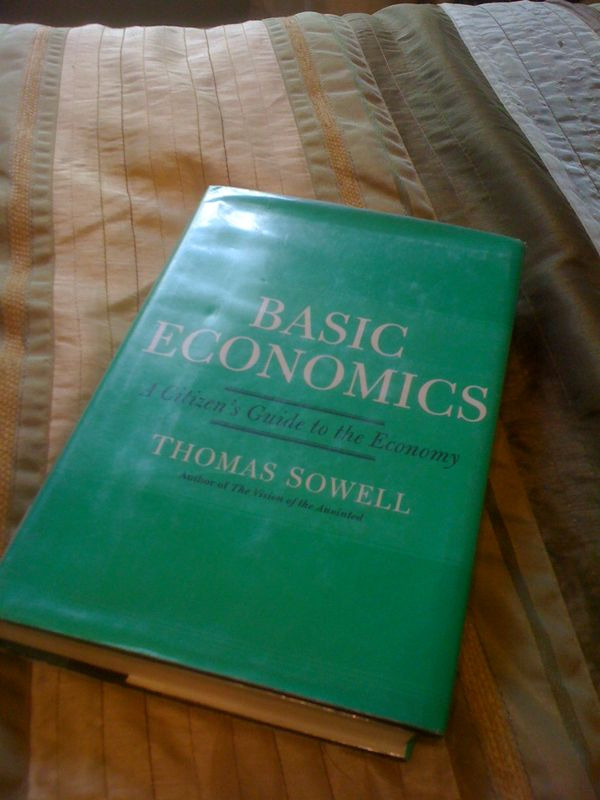
“People who charge higher prices for hotel rooms, or for other things in short supply in the wake of some disaster, are especially likely to be condemned for ‘greed,’ but in fact the relationship between supply and demand has changed. Prices are simply performing one of their most important functions – rationing scarce resources….In short, prices force people to share, whether or not they are aware of sharing.”

Economics is interesting stuff.